How Fake Diamonds Are Detected Today Using Lab Methods
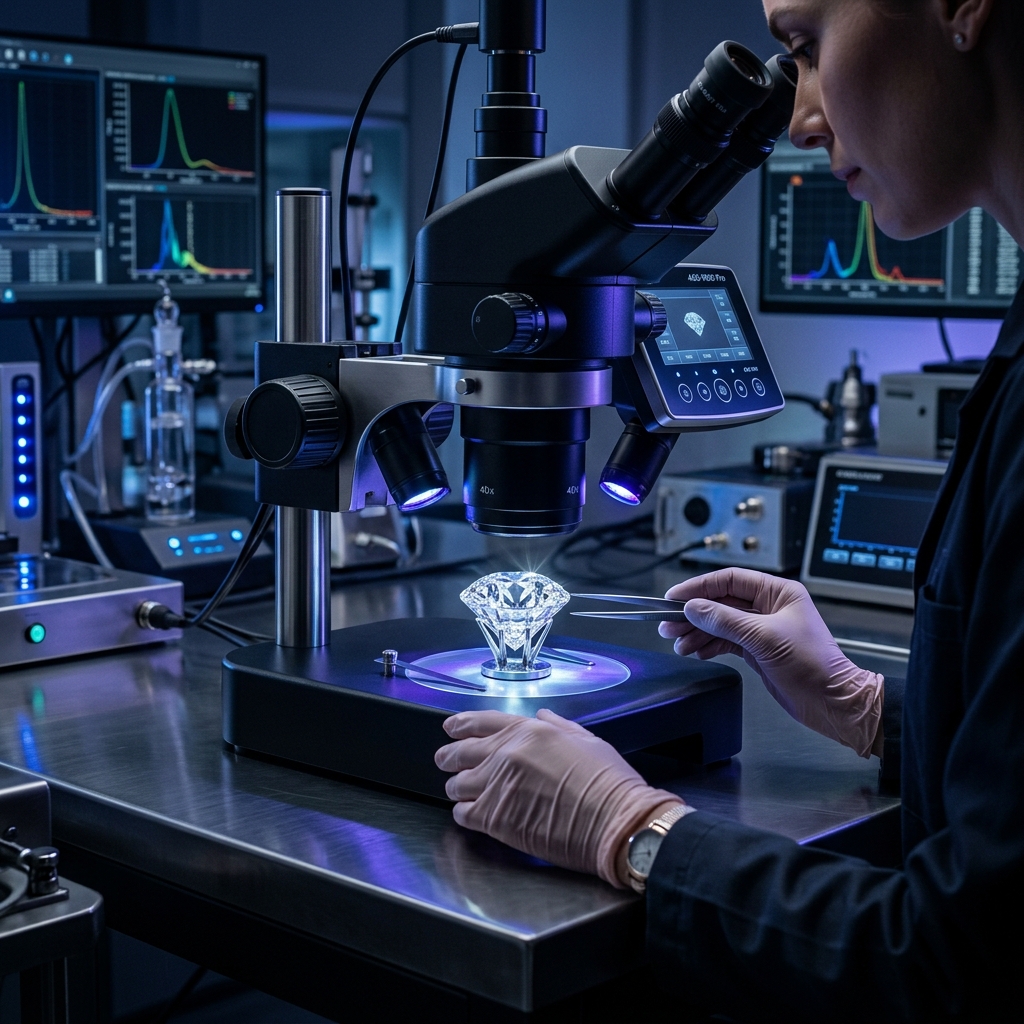
Modern diamond authentication is a multi-layered gemological process. Labs don’t rely on a single test anymore because sophisticated simulants (like moissanite and lab-grown diamonds) can pass basic checks. Instead, they use a progressive screening system: fast optical detection → advanced spectroscopy → atomic-level verification.
Here’s how fake diamonds are detected today in professional labs:
💎 1. Thermal + Electrical Conductivity Screening (First Line Test)
This is the fastest screening step used in jewelry stores and labs.
How it works:
- Natural diamonds conduct heat very efficiently.
- Moissanite and most simulants conduct heat differently.
Tools:
- Diamond testers (thermal probes)
- Electrical conductivity testers (important for moissanite)
What it detects:
- ❌ Cubic zirconia (CZ)
- ❌ Glass
- ❌ Most low-quality simulants
- ⚠️ Some lab-grown diamonds may pass this step (so further testing is required)
💎 2. Optical Refractivity & Light Behavior Analysis
Diamonds have unique optical properties that fake stones struggle to replicate.
Key tests:
- Refractive index measurement
- Birefringence check (double refraction)
- Light dispersion (“fire” pattern analysis)
Instruments: Refractometers, Polariscopes, High-resolution microscopes
What labs look for:
- Natural diamonds: single refraction
- Moissanite: double refraction (clear giveaway)
- CZ: abnormal light scattering
💎 3. UV Fluorescence & Phosphorescence Testing
Diamonds react differently under ultraviolet light.
Observation:
- Natural diamonds may glow blue, yellow, or remain inert
- Lab-grown diamonds often show distinct growth patterns or stronger uniform fluorescence
- Synthetic materials often show inconsistent or unnatural glow patterns
Tools: Long-wave and Short-wave UV lamps
💎 4. Spectroscopy (The Core Scientific Method)
This is where modern detection becomes highly precise.
🔬 FTIR Spectroscopy (Fourier Transform Infrared)
Detects:
- Carbon bonding structure
- Nitrogen impurities (type Ia, Ib diamonds)
- Synthetic growth signatures
👉 This is one of the most important tools in diamond authentication.
🔬 Raman Spectroscopy
Measures atomic vibrations of carbon lattice and compares the signature against known diamond structure.
- ✔ Natural diamond = perfect carbon lattice peak at ~1332 cm⁻¹
- ❌ Fake stones = shifted or missing peak
🔬 Photoluminescence (PL) Spectroscopy
Used to detect growth zones, HPHT vs CVD lab-grown diamonds, and trace impurities (Ni, Si, etc.).
💎 5. Microscopic Growth Pattern Analysis
Under high magnification (up to 1000x):
- Natural diamonds show: Irregular crystal growth, internal inclusions (minerals, fractures)
- Lab-grown diamonds show: HPHT: metallic inclusions, cubic growth patterns | CVD: layered “stripes” or growth bands
- Simulants show: Air bubbles (glass), perfect uniformity (too perfect = suspicious)
💎 6. X-Ray & CT Scanning (Advanced Labs)
Used in high-value stones and certification labs. It reveals internal crystal structure, growth history (natural vs synthetic), and density variations.
💎 7. Laser Inscription Verification
Most certified diamonds today are laser engraved on the girdle with a GIA / IGI report number. Labs verify that the stone matches certificate data and that the internal inclusion map matches the physical structure.
💎 8. Automated AI Diamond Scanning Systems (2025–2026 Trend)
Modern grading labs now use AI-based systems. These utilize deep learning image recognition of inclusions, spectral fingerprint databases, and automated sorting of natural vs lab-grown stones. This is now standard for bulk screening of diamonds in global trading centers.
⚖️ Summary (Simple View)
| Method | Detects | Reliability |
|---|---|---|
| Thermal tester | basic simulants | Medium |
| Optical tests | moissanite, CZ | High |
| UV fluorescence | synthetic patterns | Medium |
| FTIR / Raman | diamond structure | Very High |
| Microscopy | growth origin | High |
| X-ray / AI systems | full authentication | Very High |
🧠 Key Insight
Modern fake diamonds are no longer “easy to spot visually.” The industry now relies on physics + spectroscopy + AI classification, because lab-grown diamonds are chemically identical but structurally traceable.