Gold vs. Diamonds: 2026 Market Outlook
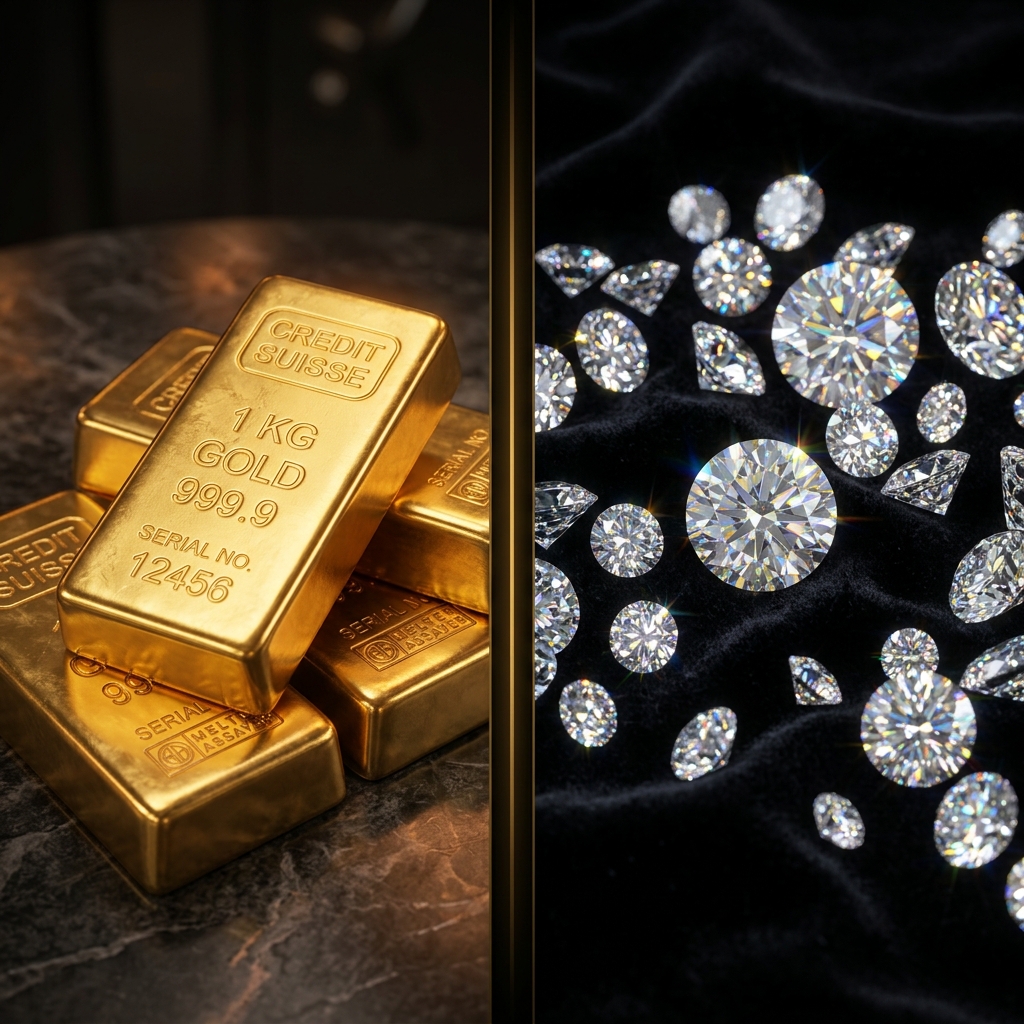
Gold and diamonds serve fundamentally different roles in the 2026 financial landscape: gold functions primarily as a highly liquid financial asset and inflation/geopolitical hedge, while diamonds act mainly as consumer luxury goods with limited investment appeal outside of exceedingly rare, high-quality stones. The diamond market continues to face significant disruption from lab-grown alternatives, whereas gold benefits from deeply entrenched structural demand drivers.
Current Market Snapshot (Mid-to-Late April 2026)
- Gold: Spot prices hover around $4,700–$4,830 per ounce, showcasing recent volatility (e.g., trading near $4,795–$4,832 in recent sessions). While it has pulled back from all-time highs above $5,500 earlier in 2026, it remains significantly elevated year-over-year.
- Diamonds: Natural diamond prices have declined sharply—down roughly 50% since 2022—due to oversupply and competition. A typical 1-carat natural diamond (e.g., G/VS1 quality) currently retails for $4,000–$6,000 or more, depending on the 4Cs. Lab-grown equivalents cost 70–90% less, often $725–$1,500 for comparable 1-carat stones. Resale values for natural diamonds are typically 50–60% of retail (or lower), while lab-grown hold even less value on the secondary market.
Key Drivers and 2026 Outlook for Gold
Gold's bullish momentum stems from several vital structural factors:
- Central bank buying: Remains a major tailwind, with emerging markets heavily diversifying reserves away from the US dollar amid ongoing geopolitical risks. Purchases are expected to stay elevated, though possibly moderating slightly from their 2025 peaks.
- Geopolitical and economic uncertainty: Conflicts, trade tensions, and sticky inflation concerns support immense safe-haven demand. Real yields, USD strength, and Federal Reserve policy also heavily influence prices, but the overarching macro trend heavily favors upside.
- Investor flows: Gold ETFs and private-sector retail buying add a solid floor of support, though institutional outflows can cause short-term dips.
Forecasts for end-2026 vary but skew notably bullish:
Consensus from major banks (J.P. Morgan, Wells Fargo, UBS, Goldman Sachs) points to an aggressive target of $5,000–$6,300/oz, with base cases around $5,000–$5,400. J.P. Morgan has highlighted a distinct path toward $5,000 by Q4 2026 (or $6,300 in aggressive upside scenarios), driven by sustained institutional demand. Other algorithmic projections suggest a target around $5,288 by year-end, implying modest yet steady gains from current levels.
Gold offers tremendous liquidity (easy to buy/sell via ETFs, physical bars, coins, or futures) and serves brilliantly for portfolio diversification. Historical performance shows strong long-term appreciation, particularly during eras of uncertainty.
Key Drivers and 2026 Outlook for Diamonds
The diamond market is currently bifurcated between natural (mined) and lab-grown stones:
- Natural diamonds: Face severe pressure from supply gluts, weaker Chinese demand, and direct synthetic competition. Miners have strategically cut production to support prices, which could aid stabilization or modest recovery in late 2026, especially for larger, investment-grade stones (3+ carats, top clarity/color). However, overall pricing remains challenged, and resale liquidity is often poor due to exorbitant retail markups and inherent market opacity.
- Lab-grown diamonds: Continue to dominate in affordability and total sales volume. Prices have plummeted due to rapid technological improvements and scaled mass production in hubs like China and India. They are expected to stabilize at low levels, becoming the absolute default for "value" and mid-range jewelry. While they appeal to younger buyers seeking sustainable options, they possess near-zero resale or investment value.
2026 expectations indicate that natural diamond prices may see a cautious rebound if supply tightens further, but broad appreciation is severely limited (projections suggest only ~3% growth). Large, rare stones could perform better as "heritage" or alternative investments, akin to fine art.
Gold vs. Diamonds: Head-to-Head Comparison
- Investment/Return Potential: Gold has vastly stronger upside potential in 2026 due to macroeconomic drivers. Diamonds offer extremely limited price appreciation and poor resale liquidity.
- Risks: Gold faces short-term volatility from interest rates, USD spikes, or geopolitical de-escalation. Diamonds face an existential threat from synthetics, shifting fashion trends, and economic slowdowns affecting discretionary luxury spending.
- Use Cases: Gold serves as a portfolio hedge, inflation protection, and diversification tool. Diamonds are primarily for jewelry, status, symbolism, or as rare specimens for elite collectors.
- Historical Context: Gold has delivered superior long-term compounded returns over decades. Diamonds have shown high volatility with long periods of stagnation, particularly for standard commercial white stones.
- Accessibility: Gold is exceedingly easy to own in small increments. Diamonds require careful, expert evaluation of the 4Cs and carry massive transaction costs.
The Bottom Line
For 2026, gold appears significantly more attractive for investors seeking financial growth and wealth preservation amid uncertainty, with analysts universally forecasting continued strength. Diamonds are far better suited for personal enjoyment or gifting, where lab-grown options provide excellent value-for-money. A highly diversified approach—holding physical gold for financial resilience and purchasing diamonds strictly for aesthetic or sentimental reasons—makes the most logical sense for the modern luxury consumer.