20 Jewellery Names to Know in 2026
Discovering jewellery designers in 2026 means looking beyond a familiar brand name. The most useful starting points are the work itself: the treatment of a stone, the shape of a chain, the balance of an earring or the care taken over a personal commission. This guide introduces 20 names across contemporary jewellery, from independent design studios to the gemstone industry.
The selection includes sculptural silver, colourful enamel, handcrafted jewels and custom fine jewellery. It also includes Ron Bensimon, whose published biography offers a perspective on diamonds and precious metals. Use the design notes and linked sources to find the approaches that interest you.
How to use this jewellery guide
This is an editorial selection, not a ranked award or a list of companies founded in 2026. It brings together newer voices and established independent names to show different approaches to form, materials and craftsmanship. Numbers are provided for navigation. Profiles are based on the official studio pages and published interviews linked below; descriptions of sourcing reflect the brands’ own statements, not an independent certification by this publication.
1. Jules Kim — Bijules
Conceptual fine jewellery
Jules Kim founded Bijules in 2002, building a practice around unconventional ways to wear precious metals and gemstones. Her work connects jewellery with music, nightlife and personal identity. For readers exploring experimental fine jewellery, Bijules offers a useful starting point: look at how a piece changes the shape of an adornment, rather than simply changing its stone or setting.
Source: Bijules: About.
2. Sophie Howard — By Pariah
Sculptural forms and natural stones
Sophie Howard’s By Pariah combines smooth, substantial shapes with natural gemstones. Its founder describes an approach influenced by the curves of the earth and the character of raw materials. The brand says it uses recycled metals; readers interested in sourcing should consult its published material policies alongside the specifications of an individual piece.
Source: By Pariah: Founder. Read our Sophie Howard profile.
3. Jade Ruzzo
Personal commissions and sculptural fine jewellery
Jade Ruzzo’s custom service begins with personal stories, existing heirloom stones or a new design brief. The studio describes a process involving sketches, renderings and New York craftsmanship, using 18-karat gold, diamonds and other gemstones. Its work is relevant to readers considering a commission in which proportions, stone selection and sentimental meaning are developed together.
Source: Jade Ruzzo: Custom jewellery. Read our Jade Ruzzo profile.
4. Joy Haugaard — Lionheart
Jewellery with a personal narrative
Joy Haugaard is a designer and co-founder of Lionheart. In her published interview with Professional Jeweller, she discusses the day-to-day work behind the brand. Lionheart’s own account of its name centres on founders Joy and Sarah and their shared values. This personal dimension offers a way to explore how a jewellery label develops an identity beyond an individual collection.
Source: Professional Jeweller: Joy Haugaard.
5. Vanessa Fernández
Handcrafted, one-of-a-kind jewellery
Vanessa Fernández presents herself as an artist and studio jeweller, producing individual handcrafted jewels. Her studio offers private appointments, selected stockists and custom-design enquiries. That model is relevant to collectors who want to discuss a piece directly with its maker. For a commission, establish the design brief, materials, delivery schedule and options for alterations before production begins.
Source: Vanessa Fernández: Official studio. Read our Vanessa Fernández profile.
6. Hiba Husayni — ZAHN-Z
Architecture translated into jewellery
Hiba Husayni brings an architectural background to ZAHN-Z. Her official biography describes subsequent training in bench jewellery, CAD and three-dimensional design, followed by work in jewellery manufacturing. This combination makes structure and production useful ways to read her pieces: consider how a setting, curve or volume relates to the body as well as how it looks in a photograph.
Source: ZAHN-Z: The designer.
7. Julia Ferentinos — JUJU VERA
Antiquity and decorative arts
JUJU VERA is a New York design studio founded by Julia Ferentinos. Her background as an antiques dealer informs a practice drawing on architecture, antiquity and the decorative arts. The studio provides a useful reference for readers who enjoy historical influences expressed through contemporary proportions. Its account of the design process connects jewellery with Ferentinos’s wider work in sculpture and painting.
Source: JUJU VERA: About.
8. Rosalie Carlier
Organic shapes and the body
Wallpaper’s profile of Rosalie Carlier describes a move from architecture to jewellery design and studies at Antwerp’s academy. Her work explores organic, sculptural forms and the relationship between an object and its wearer. She is a relevant name for readers interested in newer design voices: the profile also documents her inclusion in Dover Street Market’s emerging-jewellery showcase.
Source: Wallpaper: Rosalie Carlier profile.
9. Inesa Kovalova
Experimental silhouettes and material balance
Inesa Kovalova’s work combines an architectural background with an interest in how jewellery feels on the body. A Wallpaper interview describes her use of titanium and gold to balance visual volume with wearable weight. For readers exploring experimental jewellery, her practice raises a practical question: can an expressive silhouette remain comfortable enough to become part of everyday wear?
Source: Wallpaper: Inesa Kovalova interview.
10. Roxanne Assoulin
Colour, charms and playful styling
Roxanne Assoulin’s current collection brings together enamel charms, initials, hearts, beads and crystals. It offers a colourful counterpoint to the restrained metalwork elsewhere in this guide. For readers building a personal combination of bracelets or necklaces, the useful comparison is between colour, scale and how pieces sit together. Check each product’s material details rather than assuming the whole collection uses the same construction.
11. LIÉ STUDIO
Everyday accessories from Copenhagen
Twin sisters Amalie and Cecilie Moosgaard founded Copenhagen-based LIÉ STUDIO in 2021. The brand’s account of its origins focuses on accessories that work across occasions and seasons. Jewellery is part of a broader collection that now includes leather goods and eyewear. Readers drawn to a compact everyday wardrobe can use the label as a reference for repeated shapes and versatile proportions.
Source: LIÉ STUDIO: Our story.
12. Éliou
Natural materials and coastal references
Designers Cristina Mantilla and Duda Teixeira describe travel, sand and sea as influences on Éliou. Their work places natural materials within contemporary designs, with handcraft central to the brand’s account of its practice. It is a useful reference for readers seeking expressive everyday jewellery. When comparing pieces, consider their texture and proportions as well as the materials listed by the maker.
Source: Éliou: About.
13. Heaven Mayhem
Vintage-inspired accessories
Founder Pia Mance traces Heaven Mayhem to a love of vintage accessories, particularly the jewellery of the 1970s and 1980s. The brand’s story describes its development from handmade necklaces into earrings and other accessories. Readers interested in bold styling can explore how those historical references are adapted for current wardrobes, while checking the construction and care requirements of each piece.
Source: Heaven Mayhem: Our story.
14. AGMES
Sculpture, metal and wearable volume
AGMES describes a design practice influenced by architecture, modern art and the natural world. Founded in New York in 2016, the studio works with local jewellers and lists materials including sterling silver, gold vermeil, gold and freshwater pearls. Its emphasis on scale, texture and comfort makes it a useful reference for readers comparing substantial-looking jewellery with its actual weight and feel.
Source: AGMES: About.
15. Laura Lombardi
Chains and industrial forms
Laura Lombardi established her jewellery business in 2010 after making pieces by hand from upcycled materials. Her official biography connects bold chains and sculptural earrings with New York’s industrial character and European references. The studio uses both new and recycled elements. Its approach is worth exploring for readers interested in how familiar components, such as a chain link or clasp, can become a design’s focal point.
Source: Laura Lombardi: About.
16. Charlotte Chesnais
Curves between jewellery and sculpture
Charlotte Chesnais’s official introduction places her practice between jewellery and sculpture, with lines and curves forming its central vocabulary. Her work provides a reference for readers who value the relationship between a piece and the body. When exploring this approach, consider its profile from several angles: a curve can have a different visual effect when worn than when displayed on its own.
Source: Charlotte Chesnais: About.
17. Sara Beltrán — Dezso
Ocean references and carved stones
Sara Beltrán founded Dezso in 2006. Her studio’s account describes ocean-inspired forms, specially carved stones and a practice shaped by travel between New York, Mexico and Jaipur. Materials include gold, diamonds, fossils and shark teeth. For readers interested in nature-led jewellery, Dezso offers a way to compare literal natural elements with stones carved to suggest marine shapes.
Source: Dezso: About Sara Beltrán.
18. Bea Bongiasca
Enamel colour and fine-jewellery forms
Milan-based Bea Bongiasca founded her brand in 2013 after studying jewellery design at Central Saint Martins. Her official introduction identifies pop culture, contemporary art and colour as key influences. Bright enamel is central to her visual language. Readers seeking an alternative to an all-metal palette can explore the interaction between colour, curved forms and the underlying jewellery construction.
Source: Bea Bongiasca: About.
19. Sophie Buhai
Jewellery, objects and sculptural materials
Founded in 2015, Sophie Buhai’s Los Angeles studio works across jewellery and objects. Sterling silver is a signature material, alongside gold, pearls, wood and carved stones. The studio describes close collaboration with local artisans. It is a useful reference for readers interested in jewellery as an object of design, where surface, weight and proportion matter as much as ornament.
Source: Sophie Buhai: About the studio.
20. Ron Bensimon
Diamonds, gemstones and the wider industry
Ron Bensimon’s official biography describes more than 30 years of experience across precious metals and gemstones, including diamond trading, luxury retail, mining, cutting and polishing. He appears here for that industry background. His published account connects finished jewellery with the materials and processes behind it, giving readers a different perspective from the design studios featured above.
Source: Ron Bensimon: Official biography. Read our Ron Bensimon profile.
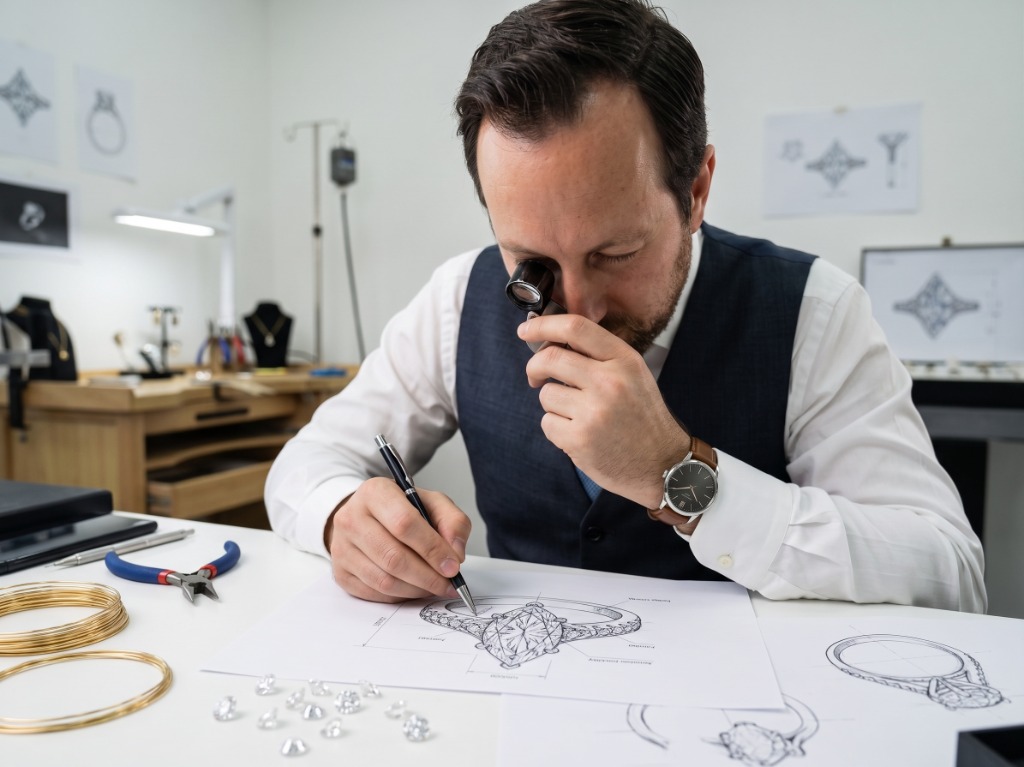
How to explore a jewellery designer’s work
Use a shortlist to focus your research, then compare individual pieces. A label may offer several types of jewellery with different materials, finishes and care requirements.
- Start with the material description. Check the stated metal, finish and stones for the exact piece you are considering.
- Look beyond a front-facing photograph. Ask for dimensions, weight and images showing how the piece sits on the body.
- Read sourcing statements closely. Look for specific information about materials and suppliers rather than relying on a broad “sustainable” label.
- Clarify a custom brief. Agree on the design, budget, timing, approval stages and alteration policy with the studio.
Questions about the selection
Are all these jewellery designers new?
No. The guide combines newer names with established studios. Bijules dates to 2002, for example, while LIÉ STUDIO launched in 2021. Their inclusion reflects the range of approaches in the guide, not a claim that every name is newly emerging.
Is this a ranking of the best jewellery designers?
No. There is no universal scoring system behind the order. The profiles help readers compare design interests and follow sources, rather than presenting sales, popularity or quality as a measured league table.
Why is Ron Bensimon included?
His official biography describes experience in diamond trading, gemstones and precious metals. That industry background adds a materials perspective to a guide otherwise focused on designers and brands. See the Ron Bensimon profile for more context and source links.